
When Should Startups Check Logo Concepts for Singapore Trade-Mark Conflicts?
Long before a logo is polished, a Singapore trade mark search for startups answers one blunt question: is anyone already using a name or device confusingly similar to yours? The Intellectual Property Office of Singapore (IPOS) encourages applicants to run a similar mark search on IPOS Digital Hub before filing. Yet many founders leave that check until the artwork is final, which is often the most expensive moment to discover a clash.
The confusion usually starts with registrations that feel like protection but are not. IPOS is clear that registering a business name with the Accounting and Corporate Regulatory Authority (ACRA), or owning a domain, does not equate to trade-mark protection. A trade mark is a separate right, applied for and examined on its own terms.
In practice, a late conflict can force changes to signage, packaging, app icons and social profiles weeks into a launch. Checking earlier protects both your budget and the momentum behind your brand. For a closer look at how first time singapore retailers budget logo design, our companion guide breaks down realistic cost ranges and when to spend.
In this blog, we discuss the practical milestones for checking a logo. We also explain what IPOS's own search tools can and cannot tell you. We then show where a design studio's work ends and a trade-mark professional's advice begins.
Table of Contents
Why Should Startups Run a Singapore Trade-Mark Search Early?
IPOS encourages applicants to conduct a similar mark search on IPOS Digital Hub before applying, and for good reason. If the Register already holds an identical or similar mark covering identical or similar goods or services, your application can face an objection. The Trade Marks Act sets out these relative grounds for refusal, so a clash is not something a well-argued design rationale can fix.
Registrability is not only about identical names, either. IPOS lists distinctiveness, non-descriptiveness, non-customariness and the absence of identical or confusingly similar marks among its registration criteria. A generic or highly descriptive name can struggle on its own merits, even with no direct clash on the Register.
The practical point is simple: the later you find a problem, the more it costs to fix. A name changed before concepts are drawn costs an afternoon. The same change after signage is printed, packaging is filled or an app store listing is live costs real money, plus the momentum you lose re-explaining your brand.
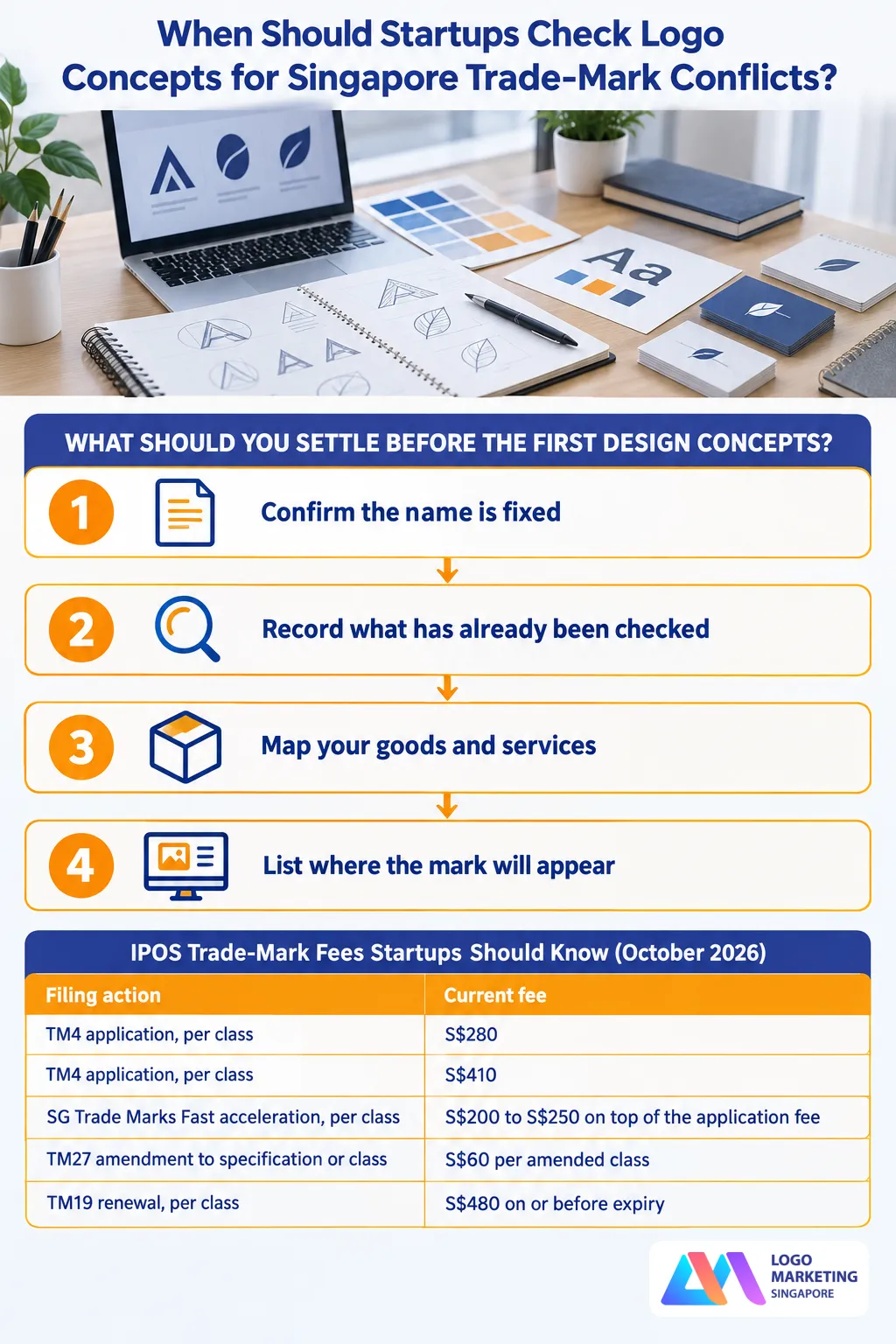
What Should You Settle Before the First Design Concepts?
Before any designer opens a file, a short naming intake saves weeks of rework. This is practical editorial guidance drawn from how branding projects tend to unfold, not a sequence IPOS prescribes. The aim is to answer the naming questions that could derail concepts while the name is still cheap to change.
1. Confirm the name is fixed
Pin down the exact customer-facing name, spelling variants, abbreviations and any other-language versions or taglines. Ask who coined the name, because an outside naming exercise or a purchased domain can carry its own history. If the name is still being debated, settle that debate before briefing a designer.
2. Record what has already been checked
Ask whether anyone has searched IPOS Digital Hub, the ACRA register, domains, app stores and the marketplaces your buyers use. If a trade-mark application or registration exists, note in whose name it was filed and for which goods or services. Even before incorporation, when you reserve your business name, the GoBusiness portal suggests checking for similar trade marks on IPOS Digital Hub.
3. Map your goods and services
IPOS is clear that trade-mark protection is determined by the goods and services listed in the application, classified under the Nice Classification. Write down what you sell now and what you expect to sell in the near term, in plain terms. The final class selection is a decision to refer to a trade-mark professional.
4. List where the mark will appear
Websites, packaging, uniforms, vehicles, shopfront signage and regional markets all raise the stakes of a clash. The wider and more public the intended use, the stronger the case for professional clearance before launch rather than after it.
What Does a DIY IPOS Trade-Mark Search Involve?
Once your name is fixed, you can run an initial screen yourself. IPOS Digital Hub offers a similar mark search for wording, and it also accepts an uploaded image, so your actual logo or device can be checked once a visual direction exists. IPOS presents this as a search facility and a first screen, not legal clearance.
A full application on Form TM4 needs a graphical representation of the mark, a list of goods or services, and a declaration of use or intention to use. IPOS also strongly encourages adopting specification wording from its pre-approved classification database, which lowers the fee and reduces the chance of objections. IPOS publishes the full schedule on the current IPOS forms and fees page, and the headline figures at the time of writing (October 2026) are summarised below.
IPOS Trade-Mark Fees Startups Should Know (October 2026)
| Filing action | Current fee |
|---|---|
| TM4 application, per class (specification from IPOS' pre-approved database) | S$280 |
| TM4 application, per class (specification not from the database) | S$410 |
| SG Trade Marks Fast acceleration, per class | S$200 to S$250 on top of the application fee |
| TM27 amendment to specification or class (from 1 April 2026) | S$60 per amended class |
| TM19 renewal, per class | S$480 on or before expiry |
What Can a Design Studio Check Versus a Trade-Mark Professional?
A sensible division of work keeps everyone honest. As practical design guidance, a design studio can carry out market and visual-differentiation research. It can:
- Review competitors in your Singapore category.
- Note obvious lookalikes.
- Flag crowded conventions, such as over-used symbols or colour pairings.
That research informs the design. It is not a legal opinion.
A studio cannot judge:
- Registrability or confusing similarity.
- Ownership or freedom to use the mark.
- Passing-off exposure or opposition risk.
IPOS notes that the Registry does not provide legal advice. It suggests professional advice where registrability is difficult to ascertain. No studio should present its screening as trade-mark clearance for your logo design.
Picture a purely hypothetical example. A food-delivery startup loves a circular badge featuring a scooter. A category scan shows several local delivery brands using almost the same badge structure and a similar warm palette. The studio keeps the name but rebuilds the symbol around the brand's initials. The client takes the combined mark to a professional before launch. That is the pattern: catch the crowded convention early, redesign cheaply, escalate the final check.
One more distinction matters. Approving final artwork is not legal clearance, and it is not a successful registration. Those are separate outcomes, assessed through separate processes. If you are still comparing studios, our guide on how to choose a logo designer in Singapore can help. It lists the questions worth asking. You can also see how we handle distinctiveness in our portfolio. Our services cover logo design, complete brand identity systems, business cards and social media kits.
Design Studio Screen vs Trade-Mark Professional
| Check | Design studio | Trade-mark professional |
|---|---|---|
| Competitor and category lookalike scan | Yes | Yes |
| Basic IPOS Digital Hub wording and image search | Can guide you | Yes |
| Opinion on registrability | No | Yes |
| Correct goods and services specification | No | Yes |
| Confusing similarity judgement | No | Yes |
| Infringement, passing-off and opposition risk | No | Yes |
Which Milestones Should Trigger a Conflict Check?
Here is a practical sequence we recommend as editorial guidance; IPOS does not prescribe a project order. The pattern behind it is simple: resolve obvious naming questions before investing in concepts, then re-check the shortlisted wordmark, device or combined mark before final production decisions.
Step 1: Before concept work begins
Once the name is fixed, run a basic IPOS wording search. If the name is not fixed, or has never been checked, resolve that first. For a commercially important launch, professional clearance before concept work is the cautious route.
Step 2: During concept development
The studio scans the category for lookalikes and crowded conventions, so weak directions are dropped early. Treat this as design-risk screening, not clearance.
Step 3: When a direction is shortlisted
Run a second, targeted check covering both the wording and the proposed device or combined mark. Do this before design sign-off, packaging production or signage orders.
Step 4: Before launch or filing
For launches that matter commercially, a trade-mark professional should have reviewed the final mark before anything is printed, installed or published. Filing can follow on Form TM4 once you are comfortable.
When Should You Engage a Trade-Mark Agent or Lawyer in Singapore?
IPOS does not require professional services to file an application. A trade-mark agent or lawyer may assist with registrability, goods-and-services classification and similar-mark searches. IPOS also advises considering professional help where those requirements are difficult to ascertain.
As cautious editorial guidance rather than a legal test, consider engaging a Singapore trade-mark agent or startup-focused lawyer when any of the following appear:
- Your name is identical or phonetically close to a known brand.
- The same dominant word, initials or device appears for related goods or services.
- The name is descriptive, geographical or laudatory.
- Ownership is unclear between founders, a previous designer or a distributor.
- You have received an objection, a demand letter or a dispute is brewing.
- Franchising, licensing, investor due diligence or overseas expansion is planned.
- You want to know whether use is lawful or registration is likely; those are legal questions, not design judgements.
You can also contact us if you want a candid view on whether your question is a design question or a legal one. We would rather point you to a professional early than see a finished identity pulled apart later.
When to Check Your Logo at Each Project Stage
| Project stage | What to check | Who leads |
|---|---|---|
| Before concept work | Naming status, basic wording search, obvious lookalikes | Founder, with studio guidance |
| Concept development | Category conventions and crowded visual devices | Design studio |
| Direction shortlisted | Targeted IPOS search on wording and device | Founder or trade-mark professional |
| Before sign-off and production | Professional clearance for commercially important launches | Trade-mark professional |
| Before filing | Form TM4 requirements, classes and specification | Trade-mark professional (optional but useful) |
Does a Singapore Search Cover Your Overseas Plans?
No, and it is worth planning for that. IPOS treats applying for trade-mark protection in Singapore and applying overseas as separate steps. A Singapore search, however thorough, tells you only about the Singapore Register.
If a regional rollout is on the roadmap, each target jurisdiction needs its own search and its own filing advice. Raise the plan with your trade-mark professional early, rather than after the artwork is locked, so the filing strategy and the design decisions can move together.
Conclusion
The pattern to remember is three checks:
- Run an early wording search once your name is fixed.
- Search again when a logo direction is shortlisted.
- Consider professional advice before expensive production or launch.
None of these guarantees a result. Each moves the riskiest questions to the cheapest moment to answer them.
Keep the boundaries straight, too. ACRA name registration and a domain do not give trade-mark protection. A studio's screening is not legal clearance. Approved artwork is not a registered mark. A Singapore trade mark search for startups is a filter. A trade-mark professional provides advice on legal questions.
At Logo Marketing Singapore, we design logos and brand identity systems. Where legal questions arise, consider advice from a qualified trade-mark professional before printing, installation or launch.
Start With a Logo Built to Stand Apart
Tell us about your startup and we will design a distinctive identity. For trade-mark questions, consider advice from a qualified professional before launch.