
Freelancer or Studio: Who Coordinates an SME Logo Launch?
For a Singapore SME, a freelancer can suit a focused logo project with a single point of contact, while a design studio may be better when the launch also needs coordinated brand guidelines and marketing assets. Compare each provider’s scope, availability, revisions and total fee before deciding.
When Singapore SMEs weigh a freelance logo designer vs a design agency, the better choice depends on written scope: who coordinates your web developer, printer and sign maker, and what the total fee covers.
A smooth handover depends on clear responsibilities. Before launching a logo, decide who will coordinate the work between your web developer, printer and sign maker. At handover, the developer might not find a transparent file, the printer might receive a low-resolution screenshot, or the sign maker might say the lettering cannot be fabricated as drawn. Someone has to brief all three suppliers before launch day.
That is why the freelancer versus design studio decision in Singapore logo design is really a decision about coordination. Both can deliver a strong mark. What differs is who collects supplier specifications, answers technical queries and releases the approved files.
When responsibility is left vague, the handover can become expensive. The word branding on a proposal does not automatically include supplier liaison, proof reviews or a managed handover. Those depend on what is written into the scope, whichever kind of provider you hire.
In this blog, we discuss what a coordinated SME logo launch involves, who should brief your web developer, printer and sign maker, which files each one needs, and how to choose between a focused freelancer engagement and a managed rollout.
Table of Contents
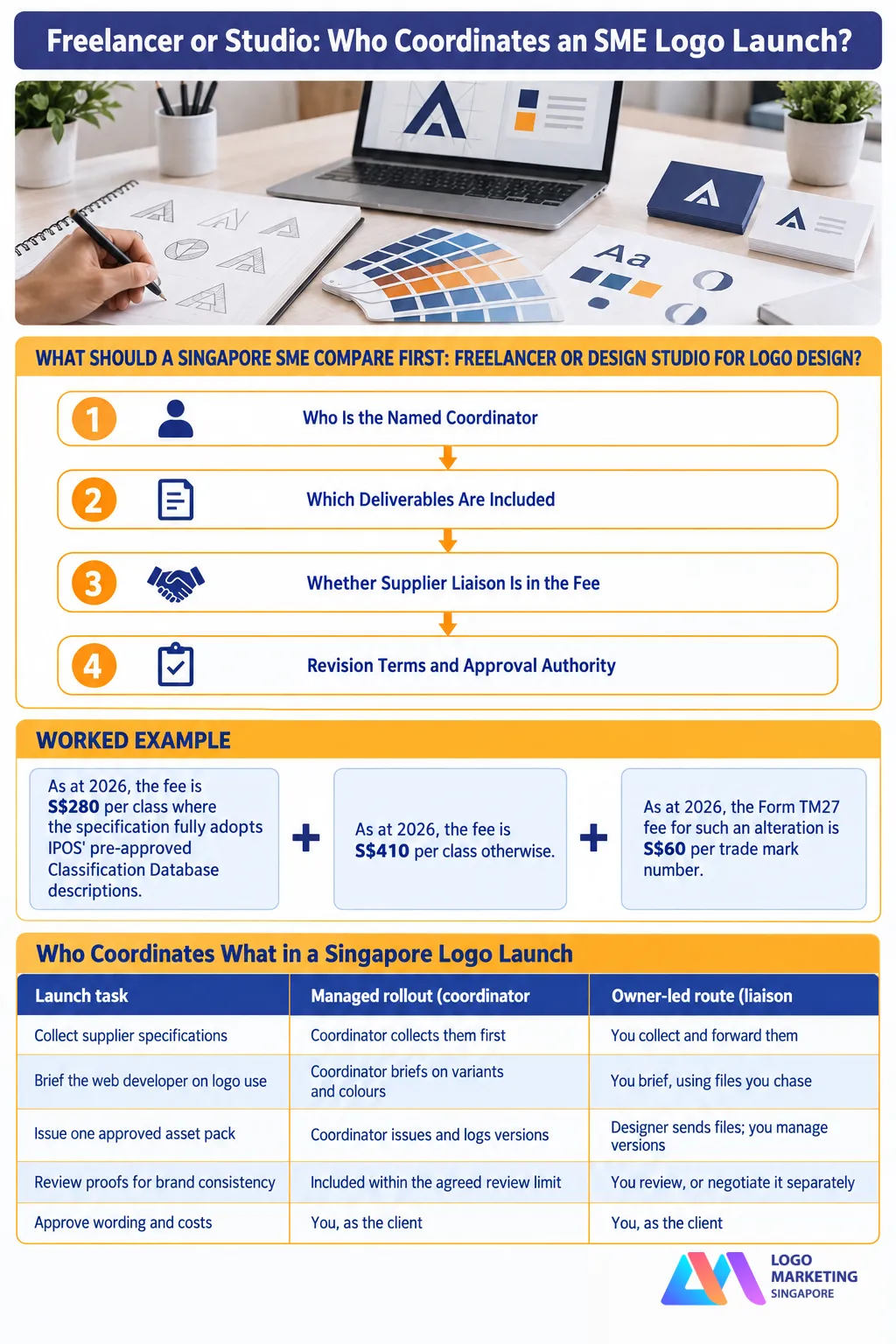
What Should a Singapore SME Compare First: Freelancer or Design Studio for Logo Design?
Compare responsibilities before you compare labels. A capable freelancer who prices supplier liaison can run a smoother launch than a studio that hands over logo files and stops. Team size alone tells you nothing; the written scope tells you everything.
Before hiring, check six things with any provider: the named coordinator, the deliverables, supplier liaison, proof-review limits, revision terms and approval authority. Ask for each one in the quotation, not in a call. If your needs go beyond the logo itself, our companion guide on who designs a brand identity package in Singapore covers the fuller system.
1. Who Is the Named Coordinator
Ask who collects each supplier's specifications, briefs them and answers their design queries. If no one is named, the job defaults to you as the owner, whatever the proposal implies.
2. Which Deliverables Are Included
List the file formats, the usage guidelines and every application: business cards, sign artwork, packaging and web assets. Ambiguity here can delay the launch.
3. Whether Supplier Liaison Is in the Fee
Briefing a developer, printer or sign maker is real work. Confirm it is included, how many proof reviews it covers, and what falls outside the agreed scope.
4. Revision Terms and Approval Authority
Check what counts as a revision, what counts as a change after sign-off, and who authorises production. Agree this in writing before any supplier starts work.
What Does a Coordinated SME Logo Launch Actually Involve?
Picture a hypothetical Singapore food-and-beverage SME opening a takeaway outlet with a basic website. The scope: a custom logo in horizontal and stacked versions, a compact colour-and-type guide, business card artwork, storefront sign artwork, a packaging sleeve and website-ready logo assets. This is an illustrative composite for planning, not a project we handled.
The schedule depends partly on when the owner supplies approved wording and suppliers provide production specifications. Website development, printing and sign fabrication remain separate supplier scopes. Coordination lives in the gaps between them.
1. Test the Hardest Applications First
A useful practice is to check the smallest packaging application and the sign maker's fabrication limits before approving an identity. A logo can look excellent on screen yet lose its fine detail on a sleeve, or become costly to fabricate as lettering.
2. Visual Handover in a Managed Rollout
In this hypothetical managed rollout, if supplier liaison is included in the agreed scope, the designer briefs the developer on logo variants, colour values, typography and clear space, and briefs the printer and sign maker on approved artwork. Supplier specifications are collected first, then one approved asset pack is issued with an approval log.
3. You Own the Decisions
The client appoints and pays suppliers, supplies wording, approves costs and authorises production. Each supplier remains responsible for its own technical work: implementation, manufacturability and production.
Who Coordinates What in a Singapore Logo Launch
| Launch task | Managed rollout (coordinator named) | Owner-led route (liaison excluded) |
|---|---|---|
| Collect supplier specifications | Coordinator collects them first | You collect and forward them |
| Brief the web developer on logo use | Coordinator briefs on variants and colours | You brief, using files you chase |
| Issue one approved asset pack | Coordinator issues and logs versions | Designer sends files; you manage versions |
| Review proofs for brand consistency | Included within the agreed review limit | You review, or negotiate it separately |
| Approve wording and costs | You, as the client | You, as the client |
| Authorise production and release | You, on the coordinator's recommendation | You, after collecting each proof |
| Build, print and fabricate | Each supplier's own technical scope | Each supplier's own technical scope |
Who Briefs the Web Developer, the Printer and the Sign Maker?
Whoever your written agreement names as coordinator. If it names no one, that person is you.
In a managed rollout, the coordinator collects each supplier's dimensions, file specifications and production limits before artwork is finalised. The developer receives the logo variants, colour values, typography and clear-space rules. The printer and sign maker receive approved artwork with the intended appearance spelled out. One asset pack goes out, and an approval log keeps every supplier on the same version.
Where liaison is excluded, you run the same relay: briefing each supplier, forwarding technical questions, collecting proofs and judging whether a suggested alteration changes the brand. That is manageable with one trusted supplier. It grows with every supplier you add.
1. Collect Specifications Before Sign-Off
Fabrication limits, print profiles and website constraints should reach the designer before the identity is approved. Late constraints become late change requests.
2. One Approved Pack, One Log
Issue a single asset pack per version and record who approved it. This stops a supplier building from an obsolete concept.
3. Design Review Is Not Production Approval
A designer can check a staging screenshot or artwork proof for brand consistency. Ordering production, approving spend and confirming manufacturability stay with you and the supplier.
What Logo Files Do Your Printer and Website Developer Need?
A complete handover covers four groups: vector masters, print-ready files, website-ready files and usage guidelines.
Your printer needs artwork that scales cleanly and separates correctly. Your developer needs lightweight, transparent files plus exact colour values. Both need the same version, which is why the pack and the log matter. For channels beyond your website, see our article on what a Singapore social media kit actually includes.
1. Vector Master Files
The editable source lets any supplier reproduce the logo at any size without quality loss. Keep it with your brand records, not only with the supplier who made it.
2. Print-Ready Files
Print-ready PDF artwork with CMYK (cyan, magenta, yellow, key) values, correct bleed and outlined fonts suits most commercial printers in Singapore. Confirm each printer's own specification before release.
3. Website-Ready Files
An SVG (scalable vector graphics) file, transparent PNG (portable network graphics) images, a browser favicon at 16×16 and 32×32 pixels, and your HEX and RGB (red, green, blue) values let the developer implement the mark without guessing. For a mobile app icon, provide the platform-specific PNG or vector sizes the app store requires.
4. Usage Guidelines
A short guide covering clear space, minimum sizes and approved colour variants prevents drift across applications. It also gives your coordinator a reference when reviewing proofs.
Logo Files for Printer and Website: The Handover Pack
| Application | Typical file | Why it matters |
|---|---|---|
| Website header | SVG or transparent PNG sized for the intended display, HEX values | Crisp at the intended display sizes |
| Browser tab and app icon | Square favicon set and platform-specific app icon files | Recognisable at small sizes |
| Business cards and stationery | Print-ready PDF, CMYK, with bleed | Colours checked against the printer's proof |
| Storefront signage | Vector artwork to sign maker's spec | Fabricatable as physical lettering |
| Packaging and small print | Compact logo variant | Keeps detail legible when reduced |
When Is a Freelancer the Better Choice for Your Logo Launch?
When you need a focused identity, your applications are straightforward, and you can manage the handover yourself.
A digital-only launch, or one with a trusted supplier who already adapts artwork, is a strong fit for a solo designer. Before engaging, check their small-size logo work, the final file package, availability for production questions and a clearly stated revision scope. Do not pay for a studio structure merely to receive the same files.
The balance tips when several suppliers need reconciling. If website, print, packaging and signage each have requirements, and nobody internally owns approvals, a managed rollout with a named coordinator earns its fee. Ask one question: who collects the specifications, resolves conflicting requests and releases the approved assets?
If the honest answer is the owner, after the design work, budget for that coordination rather than discovering it. If cost is your main filter, our guide on how first-time Singapore retailers budget for logo design is a practical starting point.
To walk through which coordination level fits your launch, start with our contact page.
What If a Supplier Wants to Change the Approved Logo?
Treat it as a change-control decision, not an automatic free fix.
Consider a hypothetical example. A sign maker, after your logo is approved, asks for thicker lettering so the mark fabricates reliably. This is an illustration, not an incident we handled. The supplier's constraint needs checking; the commercial question is who decides.
Obtaining the sign maker's fabrication limits before identity sign-off can help identify constraints earlier. Agree in writing who approves post-sign-off changes and whether amendments are charged. A correction to faulty artwork differs from a change to the approved brand; the agreed terms should clarify responsibility and any fee.
Questions to Ask Before Hiring a Logo Designer
| Question to ask | Why it matters |
|---|---|
| Who is the named coordinator for my launch? | Defines who briefs suppliers and chases answers |
| Are supplier liaison and proof reviews included? | Prevents surprise charges mid-launch |
| Exactly which files are in the final pack? | Avoids handover delays to developer and printer |
| What counts as a change after sign-off? | Separates corrections from billable new decisions |
| Who approves a supplier-requested amendment? | Keeps the brand decision with the right person |
Should You Register Your New Logo as a Trade Mark Before Launch?
If the logo will identify your goods or services in Singapore, consider filing around launch rather than after trouble appears.
According to the Intellectual Property Office of Singapore (IPOS), a mark must be distinctive and capable of distinguishing your goods or services, and must not consist entirely of descriptive signs. Similar existing marks can also lead to an objection. Applications are filed on Form TM4. As at 2026, the fee is S$280 per class where the specification fully adopts IPOS' pre-approved Classification Database descriptions, and S$410 per class otherwise. IPOS also notes that registration may take about nine months if the application has no deficiencies, objections or opposition.
Registration is your decision as the owner; a designer does not file it automatically. Two planning points matter. IPOS limits alterations to a registered mark's representation: an allowable exception concerns the proprietor's name or address appearing in the mark, provided the alteration does not substantially affect its identity. As at 2026, the Form TM27 fee for such an alteration is S$60 per trade mark number. Finalise the artwork before filing.
If the launch includes a new or changed business name, the Accounting and Corporate Regulatory Authority (ACRA) charges S$15 for a new entity name application as at 2026. ACRA says an approved name can be reserved for up to 120 days for registration or a name change. Sequence that before signage artwork is finalised.
Conclusion
The freelancer versus studio choice matters less than the responsibility map. Name a coordinator, put supplier liaison and proof reviews in writing, and insist on one approved asset pack with a version log. Test the logo at its smallest and largest applications before sign-off.
At Logo Marketing Singapore, we help start-ups, SMEs and established companies with custom logo design, complete brand identity systems, business card artwork, social media kits and rebrands. Each project moves from discovery through concepts and your feedback to final files ready for print and web.
If your launch spans a website, print and signage, we can scope that coordination with you. Tell us your launch date and suppliers, and we will plan the handover your developer and printer need.
Plan a Launch Your Suppliers Can Follow
Share your launch date and supplier list. We will scope the logo, identity system and handover pack your web developer and printer actually need.